Thursday, 31 October 2013

Qatar fund builds small stakes in BofA, Samsung - sources

The fund, one of the world's most prolific investors, has a stake worth about $1 billion in Bank of America, while its Samsung stake is worth between $200-$300 million, the sources said, speaking on condition of anonymity as the investments have not been publicly disclosed.
BofA declined to comment and QIA could not be reached for comment outside working hours.
A Samsung spokeswoman in Seoul said the company is aware of Qatar Holding's recent purchase of its shares which is said reflects the fund's support for its management.
It did not comment on the value of the purchases.
In recent months, Qatar has picked up minority stakes in companies such as oil giant Royal Dutch Shell(RDSa.L), jewellery maker Tiffany & Co(TIF.N) and Germany's Siemens(SIEGn.DE).
Buying smaller stakes means investors do not have always have to disclose ownership.
Qatar's strategy took an activist turn in 2012 when it demanded better terms from Glencore(GLEN.L) for its planned acquisition of London miner Xstrata, in which it had built up a stake of more than 12 percent, forcing Glencore to eventually raise the share swap offer.
"Qatar has taken a view that equities are cheap as an asset class and it can commit a billion dollars or two in a large company and do away with any disclosure requirements," one source familiar with the fund's plans said.
"These are mostly financial investments and very unlikely to lead into a strategic transaction for the fund. Like any investor, they would seek to buy it cheap and sell it high."
Qatar Holding, the investment arm of Qatar Investment Authority (QIA), began buying BofA shares about two years ago, the Financial Times first reported on its website.
BofA's stock closed at $14.17, up 2 cents, on the New York Stock Exchange. A $1 billion stake at this price represents less than 1 percent of BofA, which has a market capitalisation of about $151.2 billion, according to Thomson Reuters data.
It was not clear when the fund accumulated the Samsung stake. The smartphone leader has a market value of around $230.1 billion which makes the ownership considerably less than 1 percent of the company.
Under newly appointed Chief Executive Ahmed Al-Sayed, QIA has been on an aggressive expansion spree, hiring bankers and senior executives with experience ranging from mergers and acquisitions in Asia to retail and luxury investments in Europe.
The fund hired Michael Cho, a former co-head of Asia mergers and acquisitions at BofA, to run its mergers and acquisitions division.
Three sources told Reuters in September that Qatar Holding had hired Ugo Arzani, most recently a BofA managing director in London, as its new head of consumer and retail investments.
The sources said QIA, worth more than $100 billion, was scouting for opportunities in Asia and the United States in a bid to reduce its exposure to Europe and diversify its investment portfolio.

(Additional reporting by Richa Naidu in Bangalore; Editing by David Cowell)

Lenovo Hires Ashton Kutcher For Yoga Android Tablets


Houston: Ashton Kutcher, the actor who recently played Apple's iconic founder in the movie "Jobs", has taken a position with computer maker Lenovo as a product engineer.


The 35-year-old 'Two and A Half Men' star will help design and pitch its latest line of Yoga Android tablets. Kutcher is a common player in the tech sphere and has invested in startup companies such as Airbnb, Path and Uber.


Calling it "not another 'Me Too' tablet," Kutcher said that the Yoga meets consumer's needs by understanding how consumers want to use the device.


He also took a few slight jabs at Apple and its iPad by praising Lenovo for choosing Android's operating system rather than its own proprietary platform.


"Lenovo isn't sitting here going 'the software that we create is the software that needs to be the software that everybody uses because that is the software that is going to be the best software' because that is not how great software gets created," said Kutcher, almost certainly talking about Apple's popular iOS mobile OS.

Retina iPad Mini may debut on Nov. 21, Target.com suggests

Apple's hasn't yet revealed a release date for iPad Mini Retina, but a product page at Target.com may have spilled the beans.
First spotted by MacRumors, the retail giant's Web site lists the base 16GB tablet as having aNovember 21 release date. So far, the most Apple has said about a release date was that the $399 tablet would not be available until "later in November."
(Credit: Screenshot by Steven Musil/CNET)
While getting the tablet in consumers' hands a week before Thanksgiving will give Apple a jump on Black Friday sales, MacRumors notes that November 21 is a Thursday and that Apple typically launches products on Fridays.
CNET has contacted Apple for comment and will update this report when we learn more.
However, the new tablet is said to be in limited supply. Apple CEO Tim Cook alluded to possible shortages of the recently unveiled tablet during Apple's earnings conference call on Monday.
"It's unclear whether we'll have enough for the quarter or not," Cook said.
The next day, it was reported that Sharp may be responsible for the expected shortage. The Apple supplier is having problems with production yields of the 7.9-inch display for the Mini Retina, according to a Digitimes report.

Nokia Q3 2013: 8.8 Million Lumias Sold, Company Back To Profitability

The Finnish handset-maker Nokia has announced its quarterly earnings. According to the company, the phone shipment volumes increased 4% compared to previous quarter. Nokia sold 55.8 million mobile phones in the third quarter. By selling 8.8 million Lumias, Nokia continued the upward trend in Windows Phone portfolio. Much of the credit goes to the Lumia 520 (known as 521 in US), which is quite popular among budget buyers. The biggest positive here for the company was that it finally achieved profitability after bleeding money for several quarters. On the other hand, the average sale price per device dropped from USD 212 to USD 196. That's probably due to the competitively priced smartphones.
As reported earlier, Microsoft has already finalised the deal to acquire Nokia's Devices and Services business for around $7.2 Billion. So even if the Finnish company is back to profitability, it's unlikely that Nokia will cancel the deal. Under the deal, Microsoft will also get access to Nokia's patents for 10 years. In all probability, this will be Nokia's last financial report as a phone manufacturer. Post-acquisition, the Finns will retain HERE maps and NSN businesses.

Wednesday, 30 October 2013

Smartphones commandeer 70 percent of teen market

It's no secret that feature phones are rapidly going the way of the pager as smartphones continue to dominate the mobile market.
It's now to a point that smartphone saturation among teens and young adults in the US is nearly complete. According to a new study released by Nielsen on Tuesday, 70 percent of teens aged 13 to 17 now use smartphones, and 79 percent of young adults between the ages of 18 and 24 own a smartphone. In 2012, 58 percent of American teens owned a smartphone, and in 2011 only 36 percent did.
For the third quarter, 11 percent of US cell phone users upgraded their devices and nearly four-fifths of these upgrades were to smartphones. With this increase, smartphone penetration is now at 64.7 percent for all US users, up from 62 percent in the second quarter.
What types of smartphones are these people choosing? Overwhelmingly, it's Apple and Samsung devices. Apple's iPhones grabbed 41 percent of the market share and Samsung captured 26 percent. HTC and Motorola both have 8 percent, followed by LG with 7 percent. BlackBerry's 3 percent market share continued to decline, according to Nielsen.
While Apple leads in devices, Android still rules for operating systems. In the US, 52 percent of smartphone owners use Android, while 41 percent use iOS. Taking up the rear is BlackBerry and Windows with 3 percent and 2 percent, respectively.
Nielsen notes that while smartphone usage is booming in the US, it could be tapering off as the only people left using feature phones are die-hard users.
"As the smartphone market matures in the US, adoption is reaching the late majority phase, and consumers in this group may be more reluctant to replace their feature phones," Nielsen wrote in a blog post. "Device brands may want to shift their marketing muscle to appeal to this new audience, while working to not alienate their existing bases of smartphone owners."

ASUS Launches Affordable Transformer Book T100 With Windows 8.1

Taiwanese manufacturer ASUS has launched its Transformer Book T100 in India. This convertible laptop was announced back in May at Intel's Developer Forum 2013. To quote ASUS, "The Transformer Book T100 is an extremely compact ultraportable for people who want the productivity features of a laptop with the easy portability of a tablet — and the flexibility to switch between the two in an instant". We agree.
The device is powered by Intel Atom Bay Trail-T Z3740 quad-core processor clocked at 1.33 GHz. Its 10.1-inch IPS multi-touch screen has pixel dimensions of 1366x768. However, according to the press release, the product sports an "HD Glare" screen. If that's actually the case, the T100 should come with free Gunnar eyeware. We have a feeling that they meant to say, Glare-free. Other features include 7th gen Intel HD graphics, Wi-Fi, Bluetooth 4.0, Micro-USB port, Micro-HDMI port, MicroSD card slot, 3.5mm headphone, USB 3.0 port, and 1.3 megapixel front-facing camera.
The detachable keyboard accessory features a trackpad. The button layout is island type. The hybrid notebook weighs in at 1.07 Kgs (550 grams for tablet + 520 grams for dock). The ASUS Transformer Book T100 runs full-fledged Windows 8.1, which means you can run all your desktop apps without any issue. The T100 is priced at Rs 34,100, which seems like a good deal.
Here are some of the key specs of the ASUS Transformer Book T100:
  • Intel Bay-trail T Z3740, Quad Core 1.33 GHz.
  • Intel HD graphics (Gen7)
  • 10.1-inch multi-touch IPS screen.
  • 2 GB DDR3 – 1067 MHz.
  • 1.2 MP front-facing camera.
  • Wi-Fi, Bluetooth 4.0, Micro-USB port,
  • Micro-HDMI port, MicroSD card slot, 3.5 mm headphone / mic.
  • Stereo speakers with ASUS SonicMaster technology.
  • Tablet:  263 (l) x 171 (w) x 10.5 (d) mm, 550 grams.
  • Dock:   263 (l) x 171 (w) x 13.1 (d) mm, 520 grams.
  • Windows 8.1 (32-bit).

XOLO Launches Mid-Range Q900 Handset

XOLO added a new quad-core smartphone with the XOLO Q900. The newly-launched Q900 comes with a screen size of 4.7" with 312 ppi display. It runs Android 4.2 Jelly Bean and runs a 1.2 GHz processor with 1 GB of RAM. It supports full HD video playback and sports an 8 MP rear camera with LED Flash.
The XOLO Q900 comes with a 2 MP front camera for 3G video calling. Recording videos can be done at 1080p. It has 4 GB of internal storage with microSD card support for up to 32 GB. The 1800 mAh battery on XOLO Q900 claims to offer 18 hours of music playback and 5 hours of video playback. The company claims standby time of up to 384 hours on 2G and 298 hours on 3G, and talk time on 2G for 13 hours (10 hours on 3G).
Well, I was just thinking to buy the XOLO Q800 which is available for Rs10,000, but I will wait and get this new handset as soon as we are done with the test.
The XOLO Q900 will be available in white colour at Rs 13,000.
Key specifications of XOLO Q900:
  • 1.2 GHz quad-core processor.
  • Android 4.2 Jelly Bean.
  • 4.7" HD display with 312 ppi.
  • 8 MP AF rear Camera with BSI Sensor.
  • 2 MP front camera.
  • 4 GB internal storage.
  • 32 GB microSD card support.
  • 1 GB RAM.
  • 1800 mAh Battery.
  • Dual-SIM (3G+2G) support.

Tuesday, 29 October 2013

Smartphone Shipments Reach Record High, Samsung Beats Apple Again

Bangalore: Smartphone shipments have reached a record high in the third quarter with first time ever figure of 250 million units shipped globally in a single quarter, which is 45 percent more than the last year. The South Korean tech giant Samsung has retained its crown for being a top mobile shipment company in the world, and has beat Apple again, which is trailing far behind at second spot, according to market research firm Strategy Analytics.


"Samsung shipped over two times more Smartphones than Apple during the quarter," Neil Mawston, Strategy Analytics executive director, said in a statement, as reported by CNET. "While shipments of the flagship Galaxy S4 model softened, solid demand for the new Note 3 phablet and for mass-market devices like the Galaxy Y helped to lift Samsung's volumes."


Samsung noticed 55 percent surge in Smartphone shipments over the same period last year and shipped a record 88.4 million units, accounting for the 35 percent of the market share for the third quarter.  On the contrary Apple noticed a 26 percent spike in the shipments over the same period to 33.8 million units. The Cupertino giant failed to keep pace with the industry’s overall 45 percent growth and its market share dipped from 15.6 to 13.4 percent. 

Motorola unveils Project Ara, customizable smartphone effort

Motorola has announced a new initiative to help smartphone users take handset customization beyond ringtones and wallpaper to its very form and function.
The Google-owned handset company on Monday announced Project Ara, a free, open hardware platform for creating highly modular smartphones. An endoskeleton, or structural frame, holds the smartphone modules of the owner's choice, such as a display, keyboard, or extra battery, among others. The approach should allow users to swap out malfunctioning modules or upgrade as new innovations emerge, providing a handset that lasts much longer than today's smartphones.
"Our goal is to drive a more thoughtful, expressive, and open relationship between users, developers, and their phones," Motorola wrote in a company blog post. "To give you the power to decide what your phone does, how it looks, where and what it's made of, how much it costs, and how long you'll keep it."
In the works for more than a year, the project recently partnered with Dave Hakkens, the creator of Phonebloks. Although still largely in its infancy, Phonebloks build-your-own-phone approach has garnered plenty of interest online, with nearly a million people signing up to support it.
"We want to do for hardware what the Android platform has done for software: create a vibrant third-party developer ecosystem, lower the barriers to entry, increase the pace of innovation, and substantially compress development timelines," Motorola said in a blog post.
The project plans to begin inviting developers to create modules for the platform in the coming months. It also expects to release an alpha version of a module developers kit this winter.

Nokia sold 8.8 million Lumia phones in Q3

Nokia sold 8.8 million Lumia phones in the last three months, a 19 per cent increase over previous numbers driven in large part by the success of the wallet-friendly Lumia 520.
Nokia revealed the numbers today in its Q3 results for the three months from July to September. Net sales for Q3 totalled 5.7 billion euros ($7.845 billion), as the total number of units sold, including both smart phones and feature phones, rose by 4 per cent to 55.8 million.
Nokia sold 7.4 million Lumia phones in the previous quarter, but still made a loss of 115 million euros ($150 million).
It's been a tumultuous few months for what was once the biggest phone manufacturer in the world. Nokia's Windows Phone partner Microsoft is to cement its relationship with the ailing Finnish firm by buying Nokia's device and services division for $7 billion -- but Nokia CEO Stephen Elop has been criticised by the Finnish government over his "quite outrageous" bonus.
The deal is expected to be finalised at a shareholder meeting on 19 November in Helsinki.
Nokia is forging ahead with new devices, launching its first tablet, the Lumia 2520, alongside theLumia 1520 and 1320 smart phones last week. CNET met Stephen Elop at the launch of the new phones, where he told us "our challenge is to get you to try (Windows Phone and Windows RT) in the first place."

Put On Your Glares; Samsung Flashes GALAXY Golden In India

After a long time, Samsung has launched a clamshell design phone with dual-screens. Dubbed as GALAXY Golden (same as the Jackie Chan Folder phone in China), the phone comes with shiny golden accent, which according to Samsung adds to Diwali festivities. The phone has two 3.7” Super AMOLED touch screens. There's a good old numeric keypad as well. It's powered by a 1.7 GHz dual-core processor manufactured by Qualcomm. For photography, you get an 8 megapixel snapper. Other features include Wi-Fi, Bluetooth 4.0, A-GPS, 16 GB internal storage, microSD card slot, and 1820 mAh battery.
On the software front, the GALAXY Golden ships with Android 4.2 (Jelly Bean). The GALAXY Golden is available across retail stores in India for Rs 51,900. Now that's quite expensive considering Samsung's own flagship GALAXY Note sells for around 49,000. Let's not bring in the specs here, because Samsung's golden boy is meant to deliver more flaunt value than performance.
Specifications:
  • Two 3.7-inch Super AMOLED screens with pixel dimensions of 480x800.
  • 1.7 GHz dual-core processor.
  • 8 megapixel rear camera, 1.9 MP front snapper.
  • 118 (l) x 59.5 (w) x 15.8 (d) (mm), Weighs 179 grams.
  • Wi-Fi, Wi-Fi, Bluetooth 4.0, A-GPS.
  • 1.5 GB RAM, 16 GB internal storage, microSD card slot.
  • 1820 mAh battery.
  • Android 4.2 (Jelly Bean) OS.

Monday, 28 October 2013

Opportunity For Premium Class Smartphones Ending: Gartner

New Delhi: Even as the mobile phone market is expected to expand by over 5 per cent to about 1.91 billion units by 2014, the opportunity for smartphones in the premium category is now fading, global research firm Gartner has said.

The firm expects mobile phone shipments to touch 1.81 billion units this year against to 1.74 billion units in 2012.

"The mobile phone market will continue to experience steady growth, but the opportunity for high average selling price (ASP) smartphones is now ending," Gartner said, while giving its global outlook for the PC, tablet and mobile phone shipments.

The firm added that growth is expected to come from mid- tier smartphones in mature markets and low-end Android smartphones in emerging markets, like India.

Worldwide combined shipments of devices (PCs, tablets and mobile phones) are projected to reach 2.32 billion units in 2013, a 4.5 per cent increase from 2012, it said.

"The market is being driven by a shift to lower-priced devices in nearly all device categories," Gartner said.

Android will remain the leading device operating system (OS), as it is on pace to account for 38 per cent of shipments in 2013, it said.

Windows OS is projected to decline 4.3 per cent in 2013 as a result of the decline in traditional PC sales, but will return to growth in 2014 with device OS shipments increasing 9.7 per cent, it added.

Similarly, another global research firm IDC also said that mobile phone shipments will increase aided by sub-USD 200 smartphones.

Worldwide smartphone shipments are forecast to grow 40 per cent year-over-year to more than 1 billion units in 2013.

"High smartphone growth is the result of a variety of factors, including steep device subsidies from carriers, especially in mature economic markets, as well as a growing array of sub-USD 200 smartphones," it added.

Total smartphone shipments are forecast to reach 1.7 billion units in 2017, IDC said.

Overall mobile phone market is growing faster than previously forecast thanks to a stronger-than-expected first half of the year driven by strong gains in emerging markets like India and the sub-USD 200 smartphone segment.

"IDC previously projected 5.8 per cent growth for the year. Vendors are now forecast to ship more than 1.8 billion mobile phones this year, growing to over 2.3 billion mobile phones in 2017," the research firm said.

LG reveals specs for G Flex -- its curved display smartphone

LG's much-rumored G Flex will feature a 6-inch 720p curved display, according to specifications released Sunday by the company.
Weighing in at 177 grams, the G Flex measures between 7.9 and 8.7 millimeters thick at various points along its vertical arc. The handset is powered by a 2.26GHz quad-core Snapdragon 800 processor and sports 2GB of RAM, a 13-megapixel camera, and a 3,500 mAh battery.
A "dual window" mode allows the screen to be divided to accommodate multitasking and a "swing lock screen" changes the appearance of the handset's wallpaper in relation to how the device is being held and presents different unlock touch effects based on the position of the user's finger.
Comparing one of the handset's features to superhero Wolverine's ability to regenerate tissue cells to heal his wounds, LG said its smartphone will also have a "self-healing" scratch-resistant film applied to its back cover that the company promises will remove light scratches "within minutes."
The specs were included in a Korean Newswire press release that didn't offer any hints on when the consumers can expect a global rollout for the device. LG is slated to introduce the phone in November, although that date could shift.
CNET has contacted LG for more information and will update this report when we learn more.
As CNET senior editor Jessica Dolcourt explains, a flexible display doesn't mean the phone will be able to bend or flex. Rather, the display will be set at a curved -- but stationary -- position. The curve is dramatic enough to comfortably fit around your face but not so angular that it looks weird.
LG touted this technology in a press release in May and introduced a curved 55-inch OLED TV panel and 5-inch plastic OLED panel as a demonstration at a trade show.

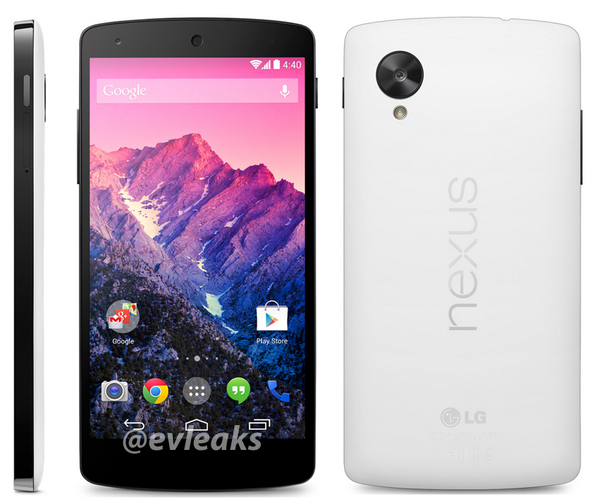
Nexus 5 leaks continue with white version outed and Nov. 1 launch teased

The not-so-mysterious Nexus 5 rears its head again.
The latest leak comes from @EVLeaks, which has generated a decent track record of posting pictures of devices ahead of their launch. It features a tweet showing a white version of Google's latest pure-Android smartphone, clad in white with a black front side.
The tweet also mentions the November 1 date, a possible hint of a launch date. There's no additional detail, so it's unclear if that means Google will unveil the phone on that day, if it will be available on Google Play on that date, or both. Previous rumors had pegged October 31 as the launch day.
Interest has picked up for the Nexus 5 as the leaks continue to drum up interest for Google's next flagship smartphone. Like the Nexus 4, the Nexus 5 is manufactured by LG under Google's guidance. The Nexus phones have slowly gained in popularity, with Android fans gravitating toward them because they include the latest version of Android. The next version, Android 4.4, is named KitKat.
Beyond the latest software, the Nexus phones, starting with the Nexus 4, had another advantage: price. The original price of the Nexus 4 was $350 unlocked, which compared favorably to a flagship smartphone like the iPhone 5S, which retails for $650 without a contract. The Nexus 5 is expected to be similarly competitively priced.

Micromax Planning To Launch Windows Phone Devices Next Year

Micromax has been receiving a lot of media attention these days. First the arrest of its co-founders made headlines. Then, the company surprised us by roping in Hollywood Star Hugh Jackman as it's brand ambassador. This time around, the domestic brand has revealed its plans of building devices on Microsoft’s Windows Phone platform.
In an interview, Micromax's Co-founder, Rahul Sharma told TOI:“We are working on a Windows phone and you might see something from us around mid of next year". As we all know, Micromax has cemented its place as an cheaper option for those who can't afford Samsung's GALAXY phones. However, due to the rising popularity of Windows Phone devices in the affordable smartphone segment, Micromax is probably hoping to provide a cheaper Lumia alternative in the market. Since the Lumia 520 already sells for around Rs 7000 in India, it will be interesting to see if Micromax can manage to launch an even more affordable Windows Phone 8 devices. One thing is for sure, any OEM joining the platform is a good news for the Windows Phone ecosystem.
On a related note, a source close to Microsoft has tipped us that the software giant is working on adding dual-SIM functionality to the Windows Phone platform.

Friday, 25 October 2013

How to sync your Windows 8.1 Start screen and desktop

Bouncing back and forth between the Start screen and desktop remains a jarring experience in Windows 8.1. But you can make the trip smoother by giving both environments the same look.
Windows 8.1 offers a new option that lets you splash the same background image onto the Start screen and desktop and even keep the two images in sync. Here's how to set it up:
Launch Windows 8.1, open the desktop, and then right-click on the Taskbar. Select Properties from the popup menu. In the Taskbar and Navigation properties window, click on the Navigation tab. Check on the option to Show my desktop background on Start. Click OK.
Return to your Start screen, and you'll now see the same background that appears on your desktop. Change your desktop background anytime down the road, and your Start screen background changes as well. As a bonus, your Apps screen also gets the same treatment.

Micromax Unveils Its New Flagship Smartphone — The Canvas Turbo A250

The most popular domestic brand Micromax, has unveiled its Canvas Turbo smartphone A250. It flaunts a 5" full-HD screen. Micromax promises effortless multitasking with its 1.5 GHz quad-core processor and 2 GB of RAM. Other features include 16 GB internal storage, Wi-Fi, 3G, Bluetooth 4.0, A-GPS, and 2000 mAh battery.
The 13 megapixel camera deserves a mention, as it's loaded with Cinemagraph (we wonder if Micromax has licenced this tech from Nokia), Object Eraser, and Panorama. The Canvas Turbo runs Android 4.2.1 (Jelly Bean) out of the box. Future updates will be delivered over-the-air (OTA). Similar to the Canvas 4, this phone will offer the "unique" Blow-to-Unlock functionality. According to Micromax, the device comes pre-installed with quite a few apps including BBM "download link" (seriously), Hike, Kingsoft Office, and M!Security. The Turbo will be hit stores across the country on 26th October. It comes in Blue and White, and is priced at Rs 20,000.

Thursday, 24 October 2013

Samsung apologizes to Chinese consumers for handset flaws

Samsung issued an apology to Chinese consumers on Wednesday after China's state-run media criticized the Korean electronics giant for selling handsets with allegedly faulty memory chips.
The company offered to provide free repairs and extended warranties on seven models after a broadcast on the influential China Central Television on Tuesday reported how Samsung handsets, including the Galaxy S and Galaxy Note series, crash several times a day due to the memory chips. The report said the issue could be resolved with a $100 chip upgrade that was not covered under current warranties.
In a statement posted to Samsung's China Web site, the electronics giant apologized for the inconvenience, which it blamed on "management problems." It also pledged to repair affected devices, refunds on previously-repaired devices, and replacement handsets in some cases.
Samsung is not the first tech coming to come under CCTV scrutiny for its warranty practices. In April, Apple CEO Tim Cookissued an apology over its warranty policies in China and promised improved services after a report on the station. The initial report claimed Apple repaired only broken or otherwise faulty parts within its products for customers in China, versus providing new replacements in other countries.
Cook's apology came during Apple's continuing efforts to land an iPhone distribution deal with the world's largest mobile carrier. Support from China Mobile, which has about 745 million customers, would open up a vast number of new customers for Apple.
Meanwhile, Samsung hopes its apology goes a long way toward helping it maintain its lead position in China's smartphone market. The company sold 30 million devices in the country last year for a 17.7 percent market share, outpacing the 11 percent share commanded by No. 3 Apple.

LG Electronics' third quarter hurt by handset competition

LG Electronics' announced Thursday that its third-quarter net income slid 34 percent due to price cuts and marketing costs associated with its latest flagship handset launch.
The South Korea electronics maker reported net income of 108.5 billion won ($103 million) for the three-month period ended September 30 compared with 156 billion won ($147.7 million) for the year-ago period.
Even though the company reported selling 12 million smartphones for the quarter, the company's mobile communications business slipped into the red for the first time in five months, recording an operating loss of 79.7 billion won ($75.5 million) on sales of 3.05 billion won ($288.8 million).
The company had hoped to get a boost from its 5.2-inch G2 smartphone, which was launched in August. But its profitability was hurt by higher marketing costs promoting the handset and increased competition from Samsung and Apple, which forced it to cut prices.
Meanwhile, the company's home-entertainment division had an operating profit of 124.4 billion won ($117.8 million) in the third quarter on declining global TV demand.
Overall, the company recorded quarterly sales of 13.9 trillion won ($12.5 billion), a 5 percent increase over the year-ago period but an 8.8 percent decline over the previous quarter. Operating profit increased 27 percent to 217.8 billion won ($196.34 million).